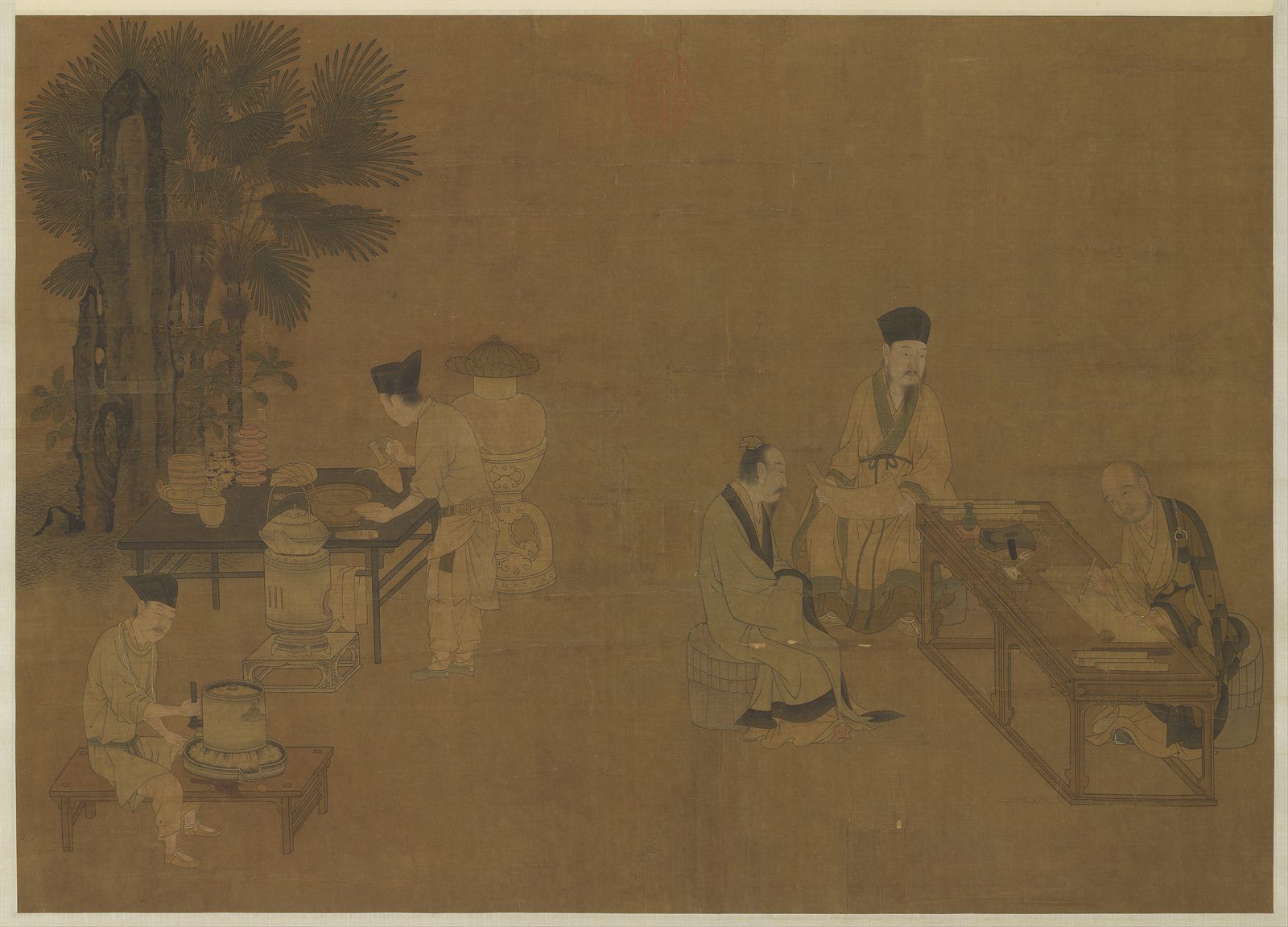
The history of tea can be told in two different ways.
One is the history of the tea plant: where it grew, how people discovered it, and how it became cultivated.
The other is the history of tea drinking: when people began to use tea, why they valued it, and how it became part of medicine, ritual, religion and daily life.
The third episode of this Chinese tea culture course begins with origin legends because those stories reveal how Chinese culture imagined tea before tea became a refined aesthetic object.
These legends should not be treated as literal history. Their value lies elsewhere: they show what meanings people attached to tea.
Lu Yu's Starting Point: Shennong and Duke Zhou
Lu Yu's The Classic of Tea contains one of the most famous lines in tea culture:
Tea as a drink began with Shennong and became known in the time of Duke Zhou of Lu.
The Chinese Text Project version of Cha Jing, section "Six: Drinking", preserves the sentence as: "茶之为饮,发乎神农氏,闻于鲁周公."
This is not an archaeological claim in the modern sense. It is a cultural origin statement. Lu Yu reaches back to Shennong, the mythic figure associated with agriculture, herbs and tasting plants, to explain tea's early meaning.
In that frame, tea first appears less as a refined drink and more as a plant with medicinal and bodily significance.
Shennong: Tea as Medicine and Detoxification
The Shennong story is the most important Chinese tea-origin legend.
In one version, Shennong tastes hundreds of herbs, encounters many poisons and is saved by tea, or by "tu" or "cha" in older terminology. The details vary, but the structure is consistent: tea is linked with testing plants, understanding toxicity and protecting the body.
That does not mean we can prove Shennong personally discovered tea. It means early tea memory placed tea in the world of medicine.
| Legend figure | Tea's meaning | Cultural keywords |
|---|---|---|
| Shennong | Herb testing, detoxification, bodily knowledge | Medicine, agriculture, plants |
| Zhuge Liang | Relief from miasma and frontier illness | Southwest China, practical use |
| Wu Lizhen | Planting and cultivating tea | Mengding Mountain, tea cultivation |
| Bodhidharma | Staying awake during meditation | Chan/Zen, religion, alertness |
Zhuge Liang: Tea and the Southwest
Another legend connects tea with Zhuge Liang's southern campaigns.
The story says that soldiers suffered from miasma or illness in the southwest, and local people used tea leaves boiled in water to help them. The story is not a verifiable military record, but it is culturally revealing.
It connects tea with the southwest.
That matters because many tea-origin discussions, both traditional and modern, point toward southwest China. Modern studies often identify southwest China, including regions such as Yunnan and Guizhou, as an important centre of tea plant origin and diversity.
Legend and science are not the same kind of evidence. Still, it is striking that cultural memory repeatedly associates tea with southwest mountains, medicinal plants and borderland experience.
Wu Lizhen: From Wild Leaf to Cultivation
Wu Lizhen appears in stories connected with Mengding Mountain in Sichuan.
His legend is different from Shennong's. Shennong represents discovery and herbal knowledge. Wu Lizhen represents planting. He is associated with cultivating tea on Mengding Mountain and is often remembered in tea culture as a "tea ancestor."
This shift is important.
Tea is no longer merely something found in the wild. It becomes something selected, planted, tended and transmitted. The story turns tea from a medicinal plant into an agricultural and regional tradition.
Bodhidharma: Tea, Meditation and Wakefulness
The Bodhidharma legend gives tea a religious meaning.
In a well-known story, Bodhidharma becomes angry at falling asleep during meditation, cuts off his eyelids, and tea plants grow from them. Drinking tea then helps practitioners stay awake during meditation.
This is obviously legend, not history. But it explains why tea became so easy to connect with Buddhist and Chan/Zen practice.
Tea is light, alerting and restrained. Monks living in mountain temples needed wakefulness, simplicity and discipline. The legend turns those practical needs into a symbolic origin story.
That is why many famous teas are associated with mountains and monasteries. Nature, religion and tea culture often developed together.
What These Legends Really Teach
The best way to read tea-origin legends is not to ask only, "Did this really happen?"
A better question is: "What did people need this story to explain?"
The Shennong story explains tea's medicinal imagination.
The Zhuge Liang story explains tea's link to the southwest and practical survival.
The Wu Lizhen story explains cultivation and regional tea ancestry.
The Bodhidharma story explains tea's relationship with religious wakefulness.
Together, these stories give tea four beginnings: a bodily beginning, a regional beginning, an agricultural beginning and a spiritual beginning.
Legend Is Not the Enemy of History
Tea culture requires two kinds of caution.
First, legends are not facts. Shennong, Zhuge Liang, Wu Lizhen and Bodhidharma should not be used as simple proof of tea's exact origin.
Second, legends are not worthless. They preserve cultural memory, symbolic meaning and the questions people cared about.
In the case of tea, origin legends show that people understood tea as medicine before refinement, as a southwest plant before empire-wide culture, as cultivation before commerce, and as wakefulness before leisure.
That is why Chinese tea culture begins with stories.
FAQ
Did Shennong really discover tea?
Shennong's discovery of tea is a major Chinese legend, not a proven historical event. Its importance is cultural: it connects tea with herbs, detoxification and bodily knowledge.
Why is Lu Yu's The Classic of Tea important?
Lu Yu's The Classic of Tea is one of the foundational texts of Chinese tea culture. It gathers tea history, preparation, utensils and cultural memory into a systematic work.
Who was Wu Lizhen?
Wu Lizhen is a legendary figure associated with Mengding Mountain tea in Sichuan. He is remembered in tea culture as an early cultivator or "tea ancestor."
Is the Bodhidharma eyelid story true?
No. It is a legend. Its value is that it links tea with meditation, alertness and Buddhist monastic life.
Why do many tea-origin stories point to southwest China?
Southwest China has long been associated with tea plant resources, mountain environments and early tea memory. Modern botanical and genetic studies also often identify southwest China as an important origin and diversity centre for tea plants.