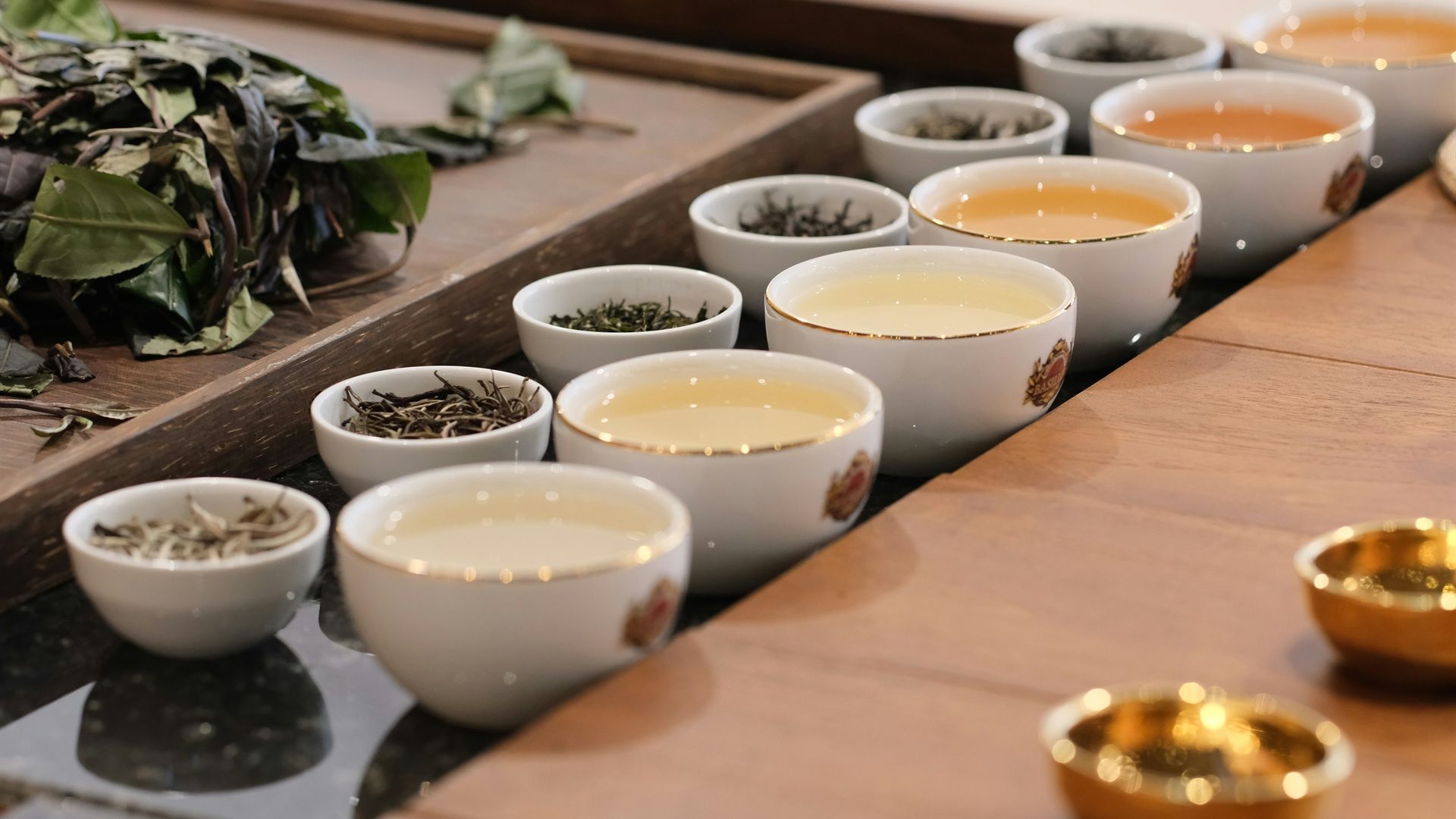
Many people begin their tea journey with bitterness.
As children, tea can taste thin, harsh and confusing. Later, the same drink may reveal sweetness, floral aroma, roast notes, freshness, aged depth and lingering aftertaste. Green tea, white tea, yellow tea, oolong, black tea and dark tea can all come from the tea plant, yet they taste dramatically different.
That leads to three useful questions:
- What are we actually drinking when we drink tea?
- Why do the six major Chinese tea categories taste so different?
- If China is such a large tea country, why has traditional tea not produced one dominant national giant?
The answers are connected.
Tea's differences come from plant chemistry and processing. The difficulty of building a single tea giant comes from fragmentation: regions, varieties, grades, channels, gifting culture and consumer habits all pull the market apart.
What Is Inside a Cup of Tea?
Tea flavor is not one thing. It is a system.
Bitterness, astringency, freshness, sweetness, aroma and color all come from different families of compounds interacting with processing and brewing.
| Sensation | Main related compounds | What they do |
|---|---|---|
| Bitterness and astringency | Tea polyphenols, caffeine | Build structure and intensity, especially in strong tea |
| Alertness | Caffeine | Affects stimulation; actual effect depends on concentration and amount |
| Freshness | Amino acids, especially theanine | Adds umami-like softness and freshness |
| Aroma | Volatile aromatic compounds | Create floral, fruity, roasted, grassy or aged notes |
| Color | Chlorophyll, carotenoids, theaflavins, thearubigins and others | Shape liquor colors from pale green to red-brown and dark brown |
| Sweet aftertaste | Polyphenols, sugars, amino acids and oral perception | A complex sensation rather than a single sweet compound |
Tea is not simply flavored water. It is the result of plant material, chemical transformation and brewing technique.
That is why leaves from the same plant family can become radically different beverages.
What Does "Fermentation" Mean in Tea?
Tea terminology can be confusing because the word "fermentation" is used in different ways.
In yogurt, wine or pickles, fermentation usually means microbial transformation. In many tea discussions, especially black tea and oolong, "fermentation" often refers to enzymatic oxidation: tea cells are bruised or broken, and polyphenols react with enzymes and oxygen.
Dark tea is different. Many dark teas involve post-fermentation, where microbial activity plays a larger role.
In simple terms:
- green tea tries to stop oxidation early;
- oolong allows partial oxidation;
- black tea undergoes more complete enzymatic oxidation;
- dark tea involves post-fermentation and aging-like transformation.
Once that distinction is clear, the six tea categories become much easier to understand.
Basic Tea Processing Steps
| Step | Purpose | Common effect |
|---|---|---|
| Plucking | Select buds, young leaves or mature leaves | Determines raw material grade and seasonal character |
| Withering | Reduce moisture and soften leaves | Prepares leaves for rolling and aroma development |
| Fixation | Heat leaves to reduce enzyme activity | Preserves green freshness and slows oxidation |
| Rolling | Break cell walls and shape leaves | Releases internal compounds and forms strips or shapes |
| Oxidation | Transform polyphenols and aroma precursors | Creates oolong and black tea flavor structures |
| Drying or roasting | Lower moisture and stabilize quality | Adds dry aroma, roast notes and shelf stability |
| Post-fermentation | Important for many dark teas | Creates aged aroma, deeper liquor and mellow texture |
Not every tea goes through every step. The identity of a tea depends on which steps are used, skipped, shortened or intensified.
The Six Major Chinese Tea Types
Green Tea: Preserving Freshness
Green tea is defined by fixation.
Fresh leaves are heated early to reduce enzymatic activity and preserve a fresher green character. This keeps much of the tea's grassy, nutty, vegetal or chestnut-like profile.
Green tea can feel vivid and refreshing, but it is also sensitive to storage and brewing. Strong green tea or empty-stomach drinking may bother some people, especially those sensitive to caffeine or astringency.
It is safer to avoid medical claims. Green tea contains polyphenols and other compounds, but tea is not medicine. Brewing strength, personal tolerance and drinking habits matter.
White Tea: Light Processing and Gentle Sweetness
White tea is usually processed through withering and drying, with relatively little intervention.
Its common profile includes light sweetness, soft texture and delicate aroma. Fresh white tea may feel clean and airy. Aged white tea may develop warmer, deeper notes.
White tea is not "unprocessed." It is simply less heavily manipulated than many other teas.
Yellow Tea: The Quiet Category
Yellow tea is known for the "menhuang" or yellowing step.
Leaves are gently transformed under controlled warmth and humidity, producing a mellow character and yellowish liquor. Yellow tea is less common than green, black or oolong tea, which is why many beginners rarely encounter it.
It should not be reduced to "slightly fermented green tea." The yellowing process gives it a distinct identity.
Oolong: Partial Oxidation and Layered Aroma
Oolong, or qing tea, sits between green tea and black tea in oxidation, but that simple description does not capture its range.
Oolong processing can involve withering, shaking, partial oxidation, fixation, rolling and roasting. The result can be floral, creamy, fruity, roasted, mineral, honeyed or deeply baked depending on style.
Tieguanyin, Wuyi rock tea, Phoenix dancong, Taiwanese high mountain tea and Zhangping Shui Xian all belong to the broad oolong world, but they can taste nothing alike.
Black Tea: Fully Oxidized and Globally Familiar
The Chinese term "hong cha" means red tea, while English calls it black tea.
The Chinese name often reflects the reddish liquor and leaf color. The English name historically focuses more on the dry leaf appearance.
Black tea undergoes more complete enzymatic oxidation. It often has a fuller body, sweeter aroma and red-brown liquor. Much of the global tea-drinking world, including British-style afternoon tea, is built around black tea.
Dark Tea: Post-Fermentation and Time
Dark tea in the Chinese sense usually refers to post-fermented tea.
Pu'er, Liu Bao and several regional dark teas are part of this discussion. Their common traits include darker liquor, thicker texture, aged aroma and mellow transformation over time.
The key idea is not simply that the tea is dark. It is that post-fermentation and storage change the tea after initial processing.
Six Tea Types at a Glance
| Type | Core process | Oxidation or fermentation | Common profile |
|---|---|---|---|
| Green tea | Fixation | Oxidation mostly halted | Fresh, grassy, nutty, vegetal |
| White tea | Withering and drying | Light natural transformation | Soft, sweet, delicate |
| Yellow tea | Yellowing step | Mild controlled transformation | Mellow, yellow liquor |
| Oolong | Shaking, partial oxidation, roasting | Partial oxidation | Floral, fruity, roasted, layered |
| Black tea | Rolling and full oxidation | Strong enzymatic oxidation | Sweet, malty, full-bodied |
| Dark tea | Piling or post-fermentation | Microbial post-fermentation | Aged, mellow, dark liquor |
Why Hasn't China Produced One Traditional Tea Giant?
China's tea market is enormous.
Tea & Coffee Trade Journal, citing preliminary 2023 International Tea Committee data, reported that China produced about 3.181 million tonnes of tea, roughly 49 percent of global production. FAO also treats tea as a major global agricultural commodity.
Yet a large market does not automatically create one dominant brand.
Traditional Chinese tea is large because it is diverse. It is fragmented for the same reason.
1. Regional Names Are Stronger Than Company Names
Chinese tea value is often attached to regions:
- West Lake Longjing;
- Wuyi rock tea;
- Anxi Tieguanyin;
- Fuding white tea;
- Pu'er;
- Liu Bao;
- Xinyang Maojian;
- Huangshan Maofeng.
When many consumers buy tea, they first ask for a region, mountain, cultivar, season or processing style. They do not always begin with a company name.
That differs from cola, instant coffee or bottled drinks, where formula and brand can dominate the buying decision.
2. Standardization Is Hard
Tea is an agricultural product.
Weather, season, altitude, cultivar, plucking standard, processing skill, storage and aging all affect taste. Even tea with the same name can vary across year, garden and maker.
Large brands prefer standardization because scale requires consistency. Serious tea drinkers often prefer variation because difference creates rarity and value.
Traditional Chinese tea sits inside that tension.
3. Distribution Is Fragmented
Traditional tea moves through many channels:
- farmers;
- primary processors;
- wholesalers;
- tea markets;
- regional merchants;
- gift channels;
- live commerce;
- brand shops;
- private customer networks.
Many purchases depend on trust, tasting, relationships and local knowledge. That creates space for small sellers but makes national brand dominance difficult.
4. Use Cases Are Fragmented
Modern beverage giants often sell simple use cases: refreshment, energy, breakfast, social drinking or convenience.
Traditional tea serves many different purposes:
- daily drinking;
- gifting;
- collecting;
- business hospitality;
- tea-room experience;
- office brewing;
- cold brewing;
- home ritual.
Each use case has a different price point, package style and trust requirement.
5. New-Style Tea Drinks Are a Different Business
China already has large tea-related brands in the new-style beverage sector.
But milk tea, fruit tea and freshly made tea drinks are not the same business as traditional loose-leaf or compressed tea. New-style tea chains rely on store operations, menus, supply chains and standardized cups. Traditional tea relies on origin, craft, grading, aging and trust.
They share the word "tea," but they do not share the same commercial logic.
What Kind of Tea Giant Could Still Emerge?
A traditional tea giant is possible, but it may not look like a single company selling every famous tea equally well.
More likely models include:
- Standardized daily-drinking tea brands that make ordinary tea easier to buy and repeat.
- Regional specialists that dominate one origin or one tea type.
- Hybrid brands that connect modern tea drinks, ready-to-drink products and higher-quality loose tea.
The core problems are simple:
- Can quality be made stable?
- Can pricing be made transparent?
- Can beginners buy without feeling lost?
The brand that reduces confusion may have the best chance.
Conclusion
The six major tea categories differ because of processing.
Green tea preserves freshness through fixation. White tea emphasizes light processing. Yellow tea adds yellowing. Oolong develops layered aroma through partial oxidation and roasting. Black tea undergoes fuller enzymatic oxidation. Dark tea gains depth through post-fermentation.
When we drink tea, we are drinking a combination of polyphenols, caffeine, amino acids, pigments, aromatic compounds and craftsmanship.
China's tea industry struggles to produce a single traditional giant not because the market is small, but because the market is richly fragmented. There are too many regions, styles, grades, channels and meanings for one brand to easily unify.
That complexity is exactly what makes Chinese tea fascinating.
FAQ
Are the six tea types classified only by color?
No. Color matters, but processing is more important. Fixation, withering, oxidation, yellowing, roasting and post-fermentation define the categories.
Why is Chinese red tea called black tea in English?
English naming historically focuses on the dry leaf appearance, while Chinese "red tea" refers more to the reddish liquor and leaf color.
Is tea a health product?
Tea contains polyphenols, caffeine, amino acids and other compounds, but it should not be treated as medicine. Moderate drinking and sensible brewing matter more than health claims.
Does tea or coffee contain more caffeine?
It depends on the brewed cup, not only the dry leaf or bean. Tea leaves may contain significant caffeine, but everyday tea is often brewed at a lower concentration than coffee.
Why does China have big new-style tea chains but few traditional tea giants?
New-style tea chains sell standardized prepared drinks. Traditional tea sells origin, craft, grade, aging and trust. The second model is much harder to scale under one brand.